About 4 Stroke Diesel Engine model
Four Stroke Diesel Engine Model
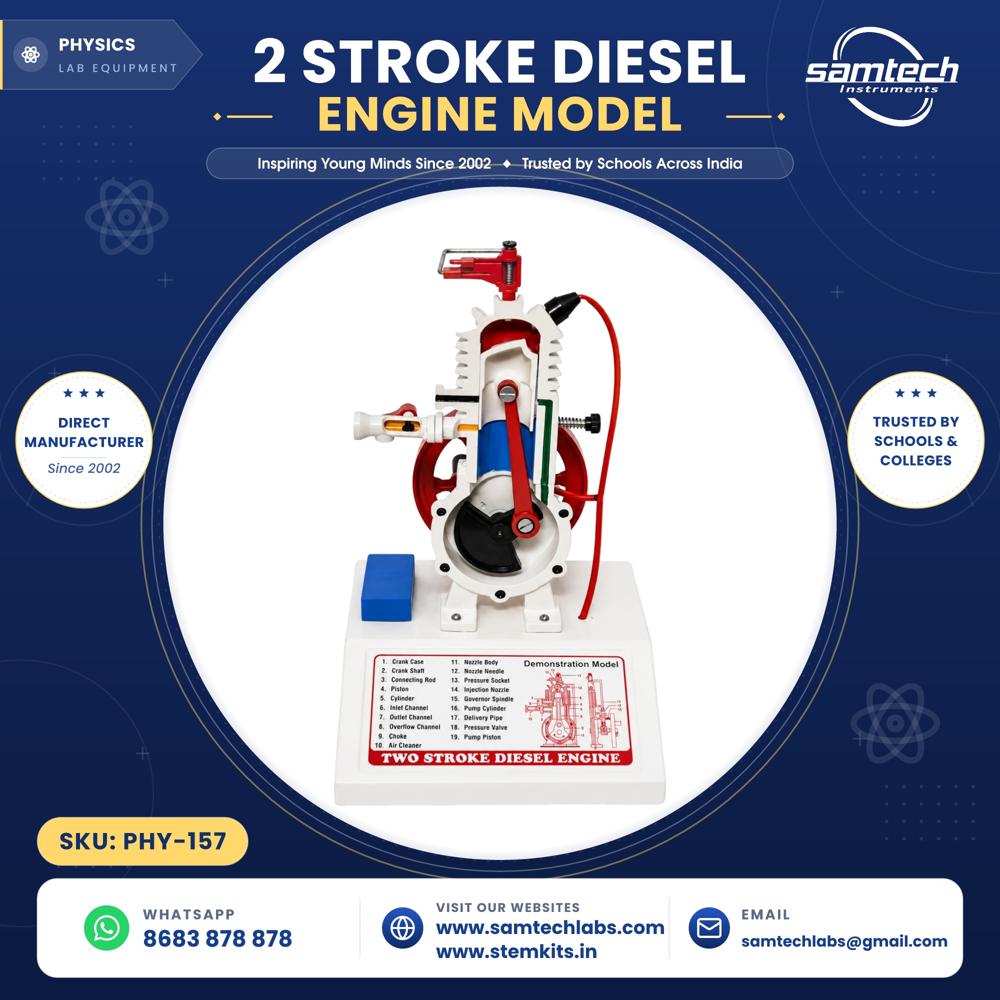
The Four Stroke Diesel Engine Model is a detailed educational demonstration model designed to illustrate the working principles of a four-stroke diesel engine. It enables students to observe the operation of key engine components and understand the complete diesel combustion cycle through hands-on learning.
Engaging, Hands-on DemonstrationThe model offers students and instructors a clear hands-on demonstration of a four-stroke diesel engine's operation, providing insight into each cycle's mechanics. Turning the hand crank simulates the actual motion of engine components, while visible oil pathways and sectional views make internal movement and engine principles accessible.
High-Quality Construction and Safety FeaturesCrafted from durable materials-mild steel, aluminum, and acrylic-and finished with powder coating and polish, the cut model is both sturdy and visually appealing. All sharp edges are smoothened to maximize user safety, ensuring the apparatus is suitable for frequent educational use without risk.
Versatile Application and Easy MaintenanceWith its compact dimensions and base mounting options (wooden/metal platform), the model integrates seamlessly into classrooms or laboratories. Maintenance is simple, requiring only occasional cleaning. The completely manual operation and non-fuel demonstration make it safe and silent for all educational settings.
FAQ's of 4 Stroke Diesel Engine model:
Q: How is the PHY-158 Four Stroke Diesel Engine model demonstrated in the classroom?
A: The model is demonstrated by manually operating a hand crank, which visually rotates the internal components to show the four-stroke cycle-intake, compression, power, and exhaust. Sectional views and visible pathways enhance understanding of the engine's function.
Q: What are the primary educational benefits of using this diesel engine cut model?
A: Students gain a practical understanding of engine mechanics, viewing the interaction of core components like the piston, crankshaft, valves, and fuel injector. It provides a tangible experience that reinforces theoretical learning, making it especially valuable for technical education.
Q: When should the model require maintenance or cleaning?
A: This demonstration model is low-maintenance and generally only requires occasional cleaning to remove dust or debris, ensuring smooth operation and clear visibility of all moving parts.
Q: Where is this engine cut model most appropriately used?
A: The model is designed for educational settings such as polytechnic and engineering college laboratories, making it ideal for use in classroom demonstrations, workshops, and student projects.
Q: What process ensures user safety during handling and demonstration?
A: All sharp edges on the model are smoothened and the mechanism operates manually without real fuel or combustion, significantly reducing any risk associated with handling. The model's construction materials add further safety and durability.
Q: What materials are used in the construction, and how does this affect the model's durability?
A: The engine cut model is made from mild steel, aluminum, and acrylic, with a powder-coated and polished surface. These materials ensure it is robust, stable, and long-lasting for repeated educational use.
 Send Inquiry





 Send Inquiry

 Send Inquiry