Crocks Radiometer About
Crookes Radiometer
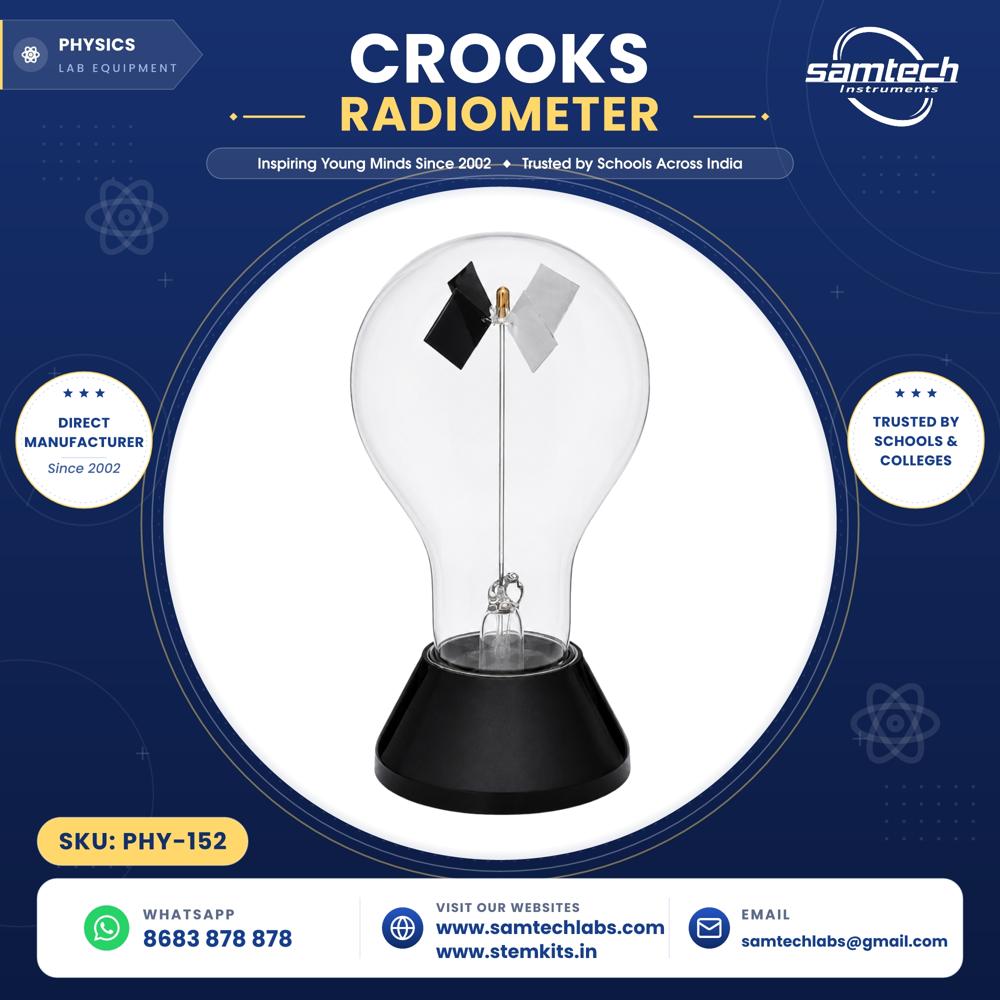
The Crookes Radiometer is a fascinating physics demonstration apparatus that illustrates the effect of radiant energy on lightweight vanes enclosed in a partially evacuated glass bulb. It is widely used to introduce students to concepts related to light, heat, and energy transfer.
Engaging Physics Demonstration ToolThe Crookes Radiometer is a fascinating apparatus for illustrating the transformation of light energy into mechanical motion. When exposed to direct sunlight or a strong lamp, the vanes within the glass globe rotate, making energy concepts tangible and captivating for learners of all ages.
Built for Educational EnvironmentsPurposefully designed for students, teachers, and science enthusiasts, this radiometer features a durable glass globe, four metallic vanes, and a stable base. Its transparent construction ensures clear observation during demonstrations in classrooms or science labs, motivating curiosity and engagement.
Simple and Maintenance-Free OperationWith a sealed vacuum interior and robust materials, the Crookes Radiometer offers an indefinite shelf life and requires no upkeep. Its analog display provides immediate, visual feedback without the need for batteries or external power sources-simply place it in strong light and observe the effects.
FAQ's of Crocks Radiometer:
Q: How does the Crookes Radiometer work?
A: The Crookes Radiometer demonstrates the radiometric effect: when exposed to light, the silver and black vanes inside the sealed glass globe rotate due to differences in thermal energy, visually showcasing light's conversion into mechanical motion.
Q: What makes this radiometer suitable for physics education?
A: Its ability to directly convert light energy to motion offers a hands-on, visual experience for understanding key physics concepts such as energy transfer and pressure, making it ideal for classroom demonstrations and lab experiments.
Q: Where should the radiometer be placed for best results?
A: To achieve optimal vane movement, position the radiometer in direct sunlight or under a powerful lamp, as it is most sensitive to intense light sources. Ambient room lighting is generally insufficient for effective operation.
Q: When should I use this device in the classroom?
A: It is best used during lessons on energy, thermodynamics, or as a visual introduction to scientific inquiry, allowing students to observe and discuss real-time physical phenomena related to light and motion.
Q: What precautions should be taken when handling the radiometer?
A: Though the device is sturdy, the glass globe is fragile and should be handled with care to prevent breakage. Avoid dropping or subjecting it to sudden shocks.
Q: Is any maintenance required for this product?
A: No maintenance is required under normal conditions, as the sealed vacuum and durable construction provide lasting reliability without need for servicing.
 Send Inquiry



 Send Inquiry

 Send Inquiry