Crookes Radiometer About
Crookes Radiometer
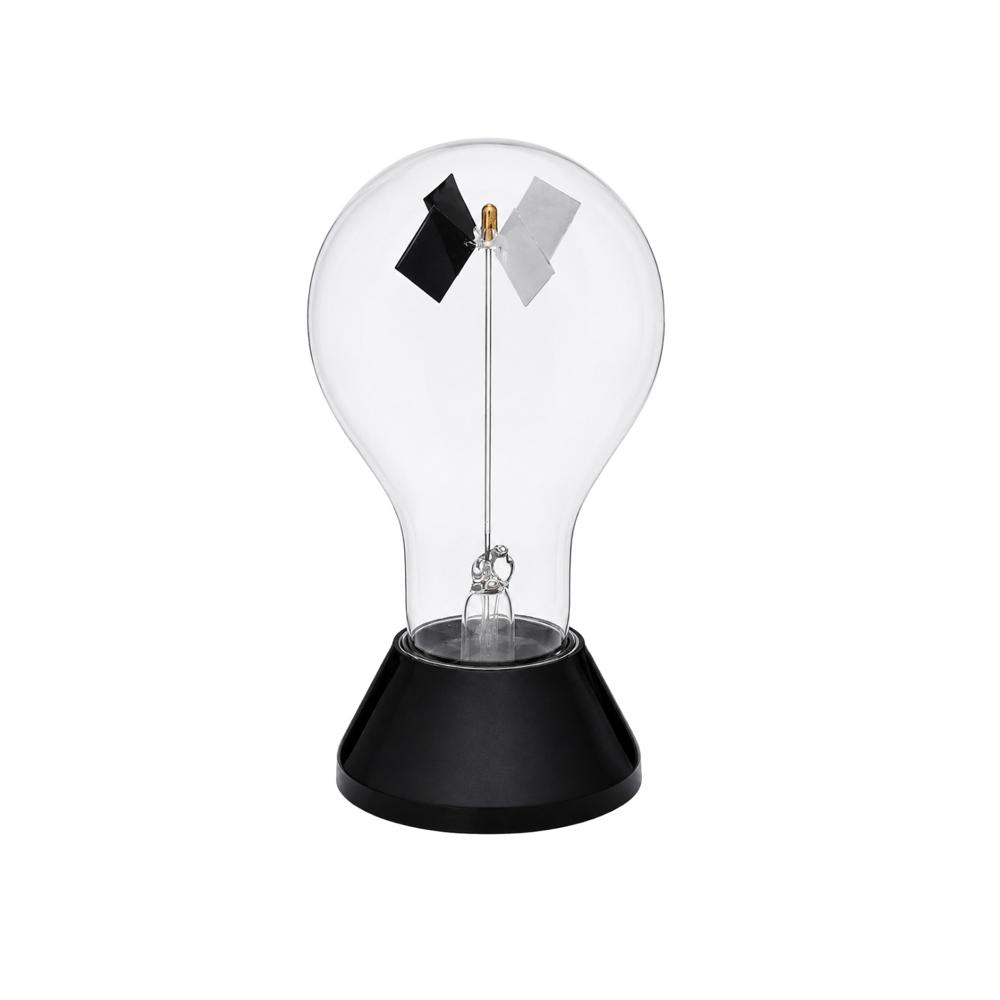
We are a leading manufacturer, supplier, and exporter of Crookes Radiometers designed for physics laboratories, science museums, STEM learning centers, and educational institutions. This classic scientific apparatus demonstrates the effects of light energy and thermal radiation through the motion of lightweight vanes enclosed in a partially evacuated glass bulb.
The Crookes Radiometer consists of four mica vanes mounted on a low-friction spindle. Each vane is black on one side and silver on the other. When exposed to light, the vanes rotate, providing a fascinating demonstration of energy transfer and gas molecule interactions inside a low-pressure environment.
This apparatus serves as an excellent teaching aid for explaining concepts related to radiation, heat transfer, light energy, kinetic motion, and vacuum physics. Its attractive design also makes it ideal for classroom demonstrations, laboratories, science exhibitions, and educational displays.
Demonstrating Light-Energy ConversionThe Crookes Radiometer offers a hands-on way to explore how light energy can be transformed into mechanical force. As one side of each vane absorbs more light, heat differences cause the vanes to spin, providing a clear visual representation of energy transfer for classrooms and science labs.
Robust and Maintenance-Free DesignManufactured with sturdy glass, metal vanes, and a stable base, this apparatus is engineered for frequent use with no need for ongoing maintenance. Its partial vacuum ensures smooth movement, and the demonstration can be performed repeatedly under normal ambient conditions.
Ideal for Educational DemonstrationsCompact and easy to use, the Radiometer makes a striking addition to any physics demonstration or science display. It illustrates otherwise intangible physical concepts, and its simple operation encourages curiosity and experimentation among students.
FAQ's of Crookes Radiometer:
Q: How does the Crookes Radiometer demonstrate the conversion of light energy to mechanical energy?
A: When exposed to sunlight or strong artificial light, the black surfaces of the vanes absorb more energy than the white or silver sides, creating a temperature difference that causes the vanes to spin. This motion visually demonstrates how light energy can be converted into kinetic energy.
Q: What types of light sources work best to make the Radiometer spin?
A: The Radiometer is sensitive to sunlight, strong lamps, and direct LED sources. Exposing it to intense, direct light will produce the best rotation effect. Ordinary room lighting may not be bright enough for significant movement.
Q: When and where is the Crookes Radiometer most commonly used?
A: This device is particularly useful during physics demonstrations in schools, colleges, and university laboratories. It is also commonly found in science displays and can be used in any setting where light energy principles are taught or explored.
Q: What is the correct process for using the Crookes Radiometer in a classroom demonstration?
A: Simply place the Radiometer on a stable surface under a strong light source. Ensure it is not handled while spinning to allow free movement of the vanes. No setup or calibration is needed, making demonstrations straightforward and immediate.
Q: What educational benefits does the Radiometer provide to students?
A: The Radiometer offers a clear and immediate visual representation of abstract physics concepts, helping students grasp the interaction between light and energy. Its engaging demonstration fosters curiosity and supports deeper understanding of physical science principles.
Q: Does the Crookes Radiometer require any maintenance or calibration?
A: No maintenance, calibration, or adjustment is required for this device. As long as it is handled gently and protected from breakage, it should function indefinitely.
Q: What materials are used in the construction of the Crookes Radiometer?
A: The primary components include a glass bulb, metal vanes (typically aluminum or similar), a spindle, and a protective plastic or metal base. These materials ensure durability while allowing clear observation of the spinning vanes.
 Send Inquiry



 Send Inquiry

 Send Inquiry