About Maxwells pendulum
Maxwell Wheel Model
We are a leading manufacturer, supplier, and exporter of the Maxwell Wheel Model, designed for physics laboratories, STEM education, engineering colleges, and classroom demonstrations. This apparatus is widely used to demonstrate the principles of conservation of energy, rotational motion, moment of inertia, and the conversion of potential energy into kinetic energy.
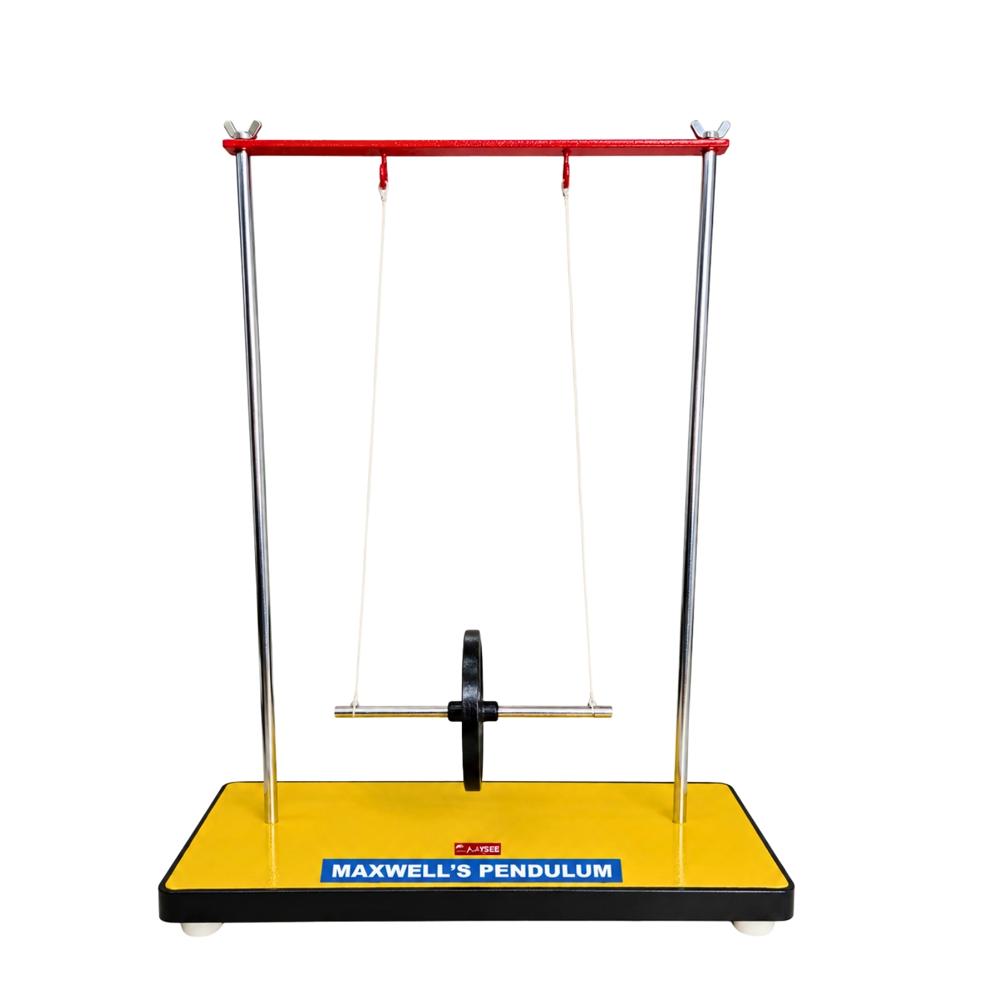
The Maxwell Wheel Model consists of a heavy flywheel mounted on a central axle and suspended by two strong nylon cords attached to a rigid support frame. When the wheel is released from an elevated position, it descends while unwinding the cords, converting gravitational potential energy into both translational and rotational kinetic energy. Upon reaching the lowest point, the stored rotational energy causes the wheel to rewind the cords and rise again, creating a continuous oscillatory motion.
This fascinating demonstration provides students with a clear understanding of energy transformation, rotational dynamics, angular momentum, and moment of inertia through direct observation and experimentation.
Precision-Engineered for Demonstrative LearningMaxwell's Pendulum boasts a sturdy, corrosion-resistant metal stand and a polished brass disc, ensuring both longevity and aesthetic appeal. The design accommodates educational settings, allowing students to observe energy transformation processes with clarity and accuracy. All materials have undergone anti-rust treatment, and its robust construction minimizes vibration, ideal for repeated laboratory use.
Easy Assembly and Safe HandlingThis apparatus offers minimal assembly, primarily requiring attachment of the disc. Box-packed with form-fitting foam, it ensures safety during transport. The heavy base and smooth pulleys guarantee stable and consistent operation during every demonstration, making it suitable for both novice and experienced users.
Educational Value and VersatilityDesigned for demonstrating Maxwell's Principle, rotational motion, and energy conservation, the pendulum is perfect for physics instruction in schools, colleges, and university labs. Manual operation, high accuracy, and durable components ensure repeatable, hands-on experiments that foster conceptual understanding.
FAQ's of Maxwells pendulum:
Q: How do you assemble Maxwell's Pendulum before use?
A: Assembly is straightforward and minimal. Typically, you only need to attach the polished brass disc to the suspension strings, which are already secured to the stand. Detailed instructions are provided in the box for your convenience.
Q: What is the primary educational benefit of using Maxwell's Pendulum in the classroom?
A: This apparatus enables direct demonstration of Maxwell's Principle, rotational motion, and conservation of energy. By observing its operation, students gain practical insights into fundamental physics concepts, making it an effective, hands-on learning tool.
Q: When should Maxwell's Pendulum be used during lab activities?
A: It is best utilized during units covering rotational dynamics, energy conversion, or principles related to mechanical motion, allowing students to visualize and interact with the concepts in real time.
Q: Where can this pendulum safely be operated?
A: Maxwell's Pendulum is designed for use on stable laboratory tables in schools, colleges, and university laboratories. Its heavy, corrosion-resistant base and anti-skid design ensure safety and stability during experiments.
Q: What materials and surfaces are used in this apparatus for durability?
A: The disc is crafted from polished brass with a corrosion-resistant, anti-rust coating; the suspension string is hardened steel or durable synthetic fiber. The stand and pulleys are coated metal, providing longevity and resistance to wear.
Q: How is the rotational motion achieved and observed?
A: The smooth-running lateral pulleys and high-precision suspension string allow the brass disc to rotate freely. By manually twisting and releasing the disc, students can observe rotational motion and energy transfer clearly.
Q: What are the key advantages of choosing this model (PHY-117)?
A: Advantages include durable and corrosion-resistant construction, precise demonstration capability, user-friendly assembly, visually appealing design, and secure foam-packed transport, ensuring long-term reliability and safe usage.
 Send Inquiry




 Send Inquiry

 Send Inquiry