About Ray Optics Kit
Ray Optics Kit
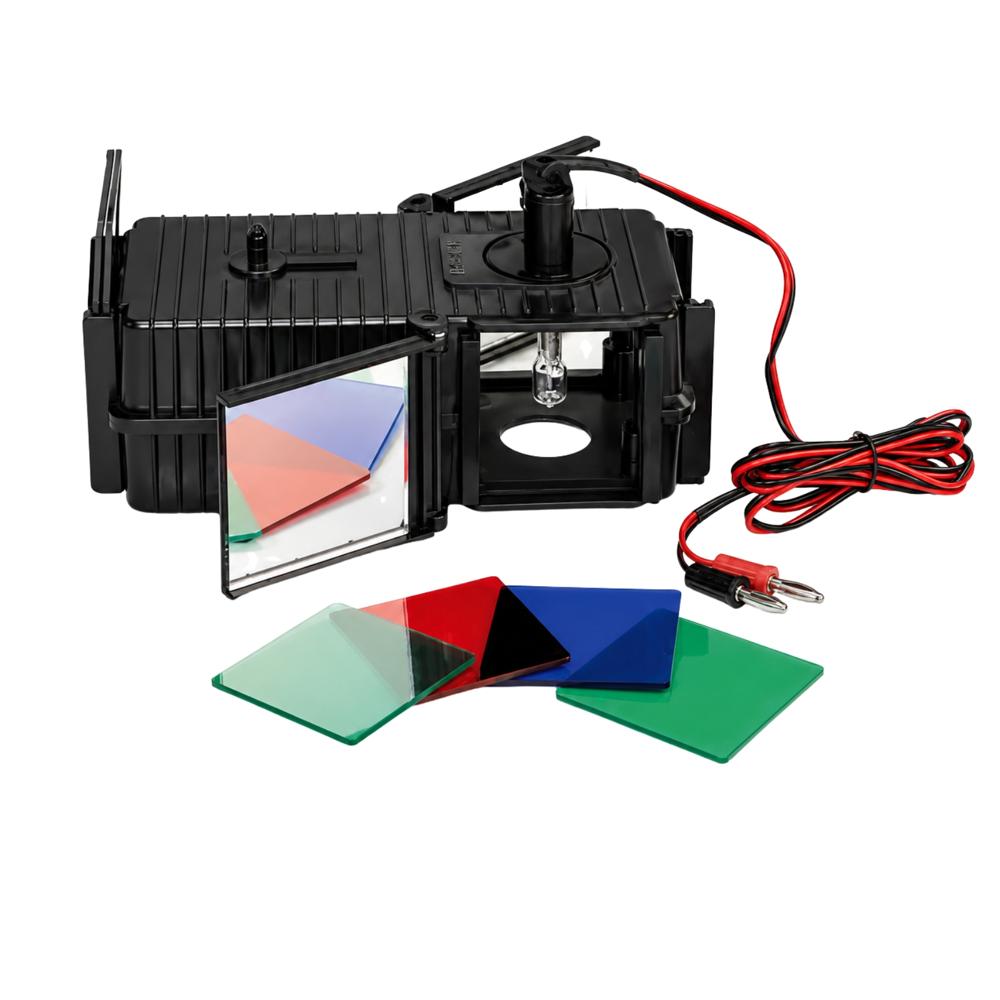
The Ray Optics Kit is a comprehensive educational physics kit designed to help students explore the principles of light and optics through hands-on experiments. The kit includes a high-quality ray box with a bright halogen lamp, hinged mirrors, and 29 optical components for conducting a wide range of optics investigations.
Ideal for school physics laboratories, STEM learning programs, and science demonstrations, the kit enables students to study reflection, refraction, image formation, color mixing, lenses, prisms, and other optical phenomena. A detailed instruction guide featuring 18 engaging activities helps learners perform experiments with ease and understand key optics concepts effectively.
The ray box operates using a 12V DC power supply and provides bright, clear light rays for accurate demonstrations. This kit is an excellent teaching aid for secondary schools, colleges, and educational institutions.
Key Features
- Complete Ray Optics Kit with 29 optical components
- High-quality ray box with bright halogen lamp
- Includes hinged mirrors and optical accessories
- Comprehensive instruction guide with 18 activities
- Ideal for reflection and refraction experiments
- Suitable for physics laboratories and STEM education
- Durable construction for long-term classroom use
- Easy setup and operation
All-Inclusive Optics Learning SolutionThe ROK-101 Ray Optics Kit brings together all core optical components required for conducting a wide array of experiments in physics labs. With lenses, mirrors, glass blocks, and a versatile ray box neatly packaged in a protective foam box, it streamlines classroom preparation while supporting educational curriculum requirements.
Precision and Durability CombinedEngineered with metal, acrylic, and glass, this optics kit is robust and built for repeated academic use. The powder-coated bench and insulated low-voltage electronics ensure longevity and safety, making it suitable for both demonstrations and hands-on student investigations into ray and image formation.
FAQ's of Ray Optics Kit:
Q: How do I use the Ray Optics Kit to study reflection and refraction?
A: You can set up mirrors and glass blocks on the optics bench, direct light from the included ray box using single or triple slits, and observe ray paths as they reflect off mirrors or refract through different media. The kit's arrangement allows for clear demonstrations of light behavior in both reflection and refraction experiments.
Q: What experiments can be conducted with this optics kit?
A: This kit enables investigations into ray tracing, reflection using plane mirrors, refraction through rectangular and triangular glass blocks, focal length determination with convex and concave lenses, and more. Its accessories support a broad range of standard physics experiments for academic purposes.
Q: When is the Ray Optics Kit typically used in educational settings?
A: The kit is primarily used during physics lab sessions dedicated to optics topics, such as ray diagrams, light properties, and image formation. It's ideal for both structured curriculum demonstrations and student-led experimentation.
Q: Where should I set up the Ray Optics Kit for experiments?
A: Set up the kit in a well-lit physics laboratory or classroom with access to AC mains (220-240 V) for the ray box. Its compact design fits standard lab benches, allowing for stable and accurate alignment of components during experiments.
Q: What is the process for aligning optical components in the kit?
A: Begin by securing the optics bench on a flat surface. Arrange the ray box at one end, and position lenses, mirrors, or glass blocks along the bench as needed for your experiment. Align the slits and components carefully for precise light paths and accurate results.
Q: How does the Ray Optics Kit benefit students and instructors?
A: It provides hands-on experience with physical optics concepts, enhancing understanding through practical demonstration. The kit is compliant with national curriculum standards, easy to use, and safe for students, making it an excellent resource for effective physics education.
 Send Inquiry



 Send Inquiry

 Send Inquiry