About Water Turbine Model -With Dynamo
Water Turbine Model with Dynamo for Renewable Energy Demonstration
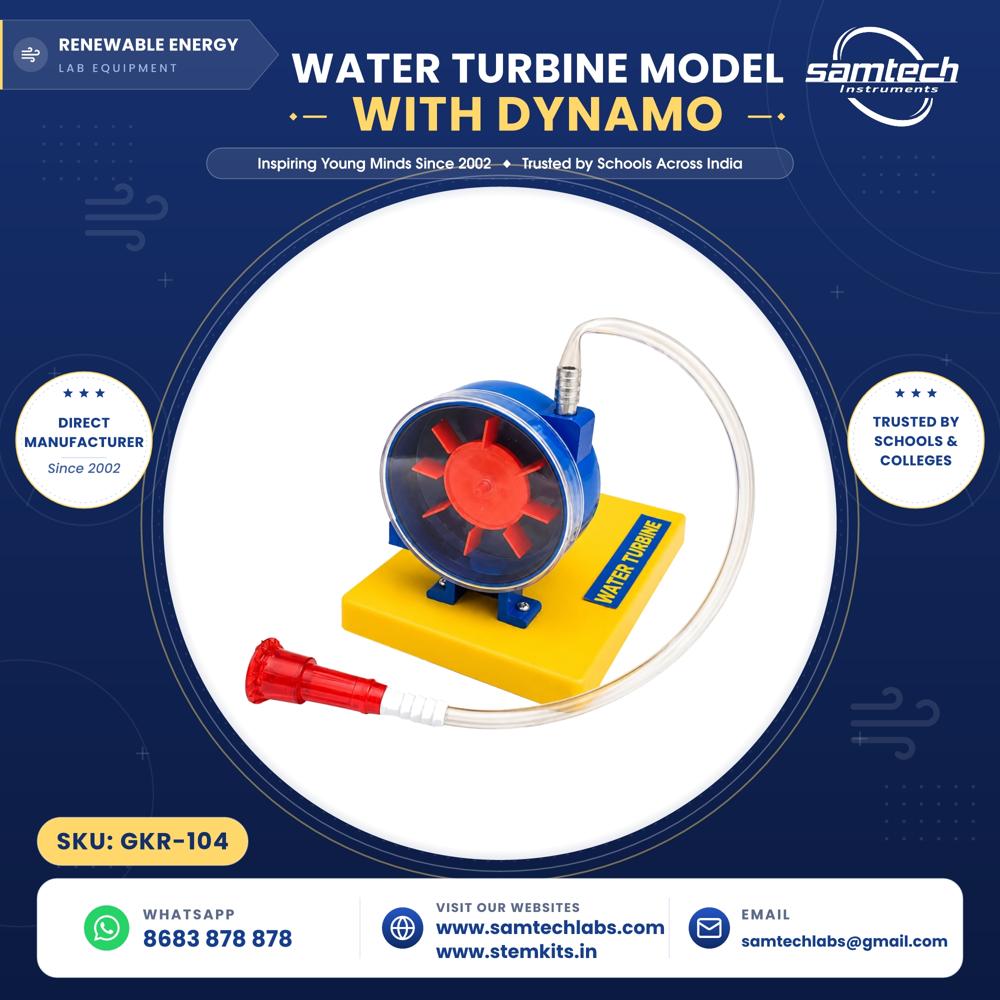
Samtech Instruments is a leading manufacturer, supplier, and exporter of Water Turbine Models with Dynamo, designed to demonstrate the conversion of water energy into electrical energy. This working educational model helps students understand hydroelectric power generation and the principles of renewable energy through practical experimentation.
The model uses flowing water to rotate a turbine connected to a dynamo, illustrating how hydroelectric power plants generate electricity. It is an ideal teaching aid for science laboratories, STEM education, and renewable energy demonstrations.
Demonstrating Hydroelectric PrinciplesThis model offers an engaging, hands-on approach to illustrating how water flow can be converted into electrical energy. Students and instructors can observe the visible motion of the Pelton wheel and the direct generation of electricity, making abstract energy conversion concepts tangible. The LED output provides immediate feedback, enhancing the learning experience during demonstrations.
User-Friendly Educational DesignCrafted for science labs, this medium-sized model is easy to handle and comes pre-assembled for immediate use. Constructed from non-toxic acrylic, metal, and plastic with a smooth, polished finish and blunt edges, it ensures classroom safety while allowing clear views of operating components. The included accessories, such as connecting pipes, support flexible setups for different demonstration needs.
FAQ's of Water Turbine Model -With Dynamo:
Q: How does the Water Turbine Model convert water flow into electricity?
A: This educational model uses a Pelton wheel turbine connected to a permanent magnet dynamo. When water is directed onto the Pelton wheel via the flexible rubber tube, the wheel spins, which in turn rotates the dynamo and generates up to 6V DC electricity, as indicated by the LED output.
Q: What is the ideal setting for using this Water Turbine Model?
A: The model is best used in educational environments such as science labs, classrooms, or physics demonstration sessions. Its compact, sturdy design makes it suitable for tabletop displays and interactive student experiments.
Q: When should maintenance be performed on the turbine setup?
A: Periodic cleaning is recommended, especially after repeated demonstrations or when you notice reduced electrical output. This ensures that water channels and moving parts remain free of debris and function optimally.
Q: Where should the water supply be connected for operation?
A: The model includes a flexible rubber tube attachment meant for the water inlet. Simply connect the tube to a steady water source-a faucet, bottle, or lab water supply-for controlled flow into the turbine.
Q: What is the main benefit of using this demonstration model in the classroom?
A: This model makes the principle of hydroelectric power generation easily understandable by allowing direct observation and measurement of energy transformation from water flow to electricity. Hands-on interaction solidifies theoretical concepts of energy conversion.
Q: How can students interact with and explore the turbine's components?
A: Many parts of the model are removable, enabling students to examine internal components like the Pelton wheel, dynamo, and water channels. This supports a deeper understanding of each stage in the energy conversion process.
 Send Inquiry





 Send Inquiry

 Send Inquiry