About Heat Conductivity model
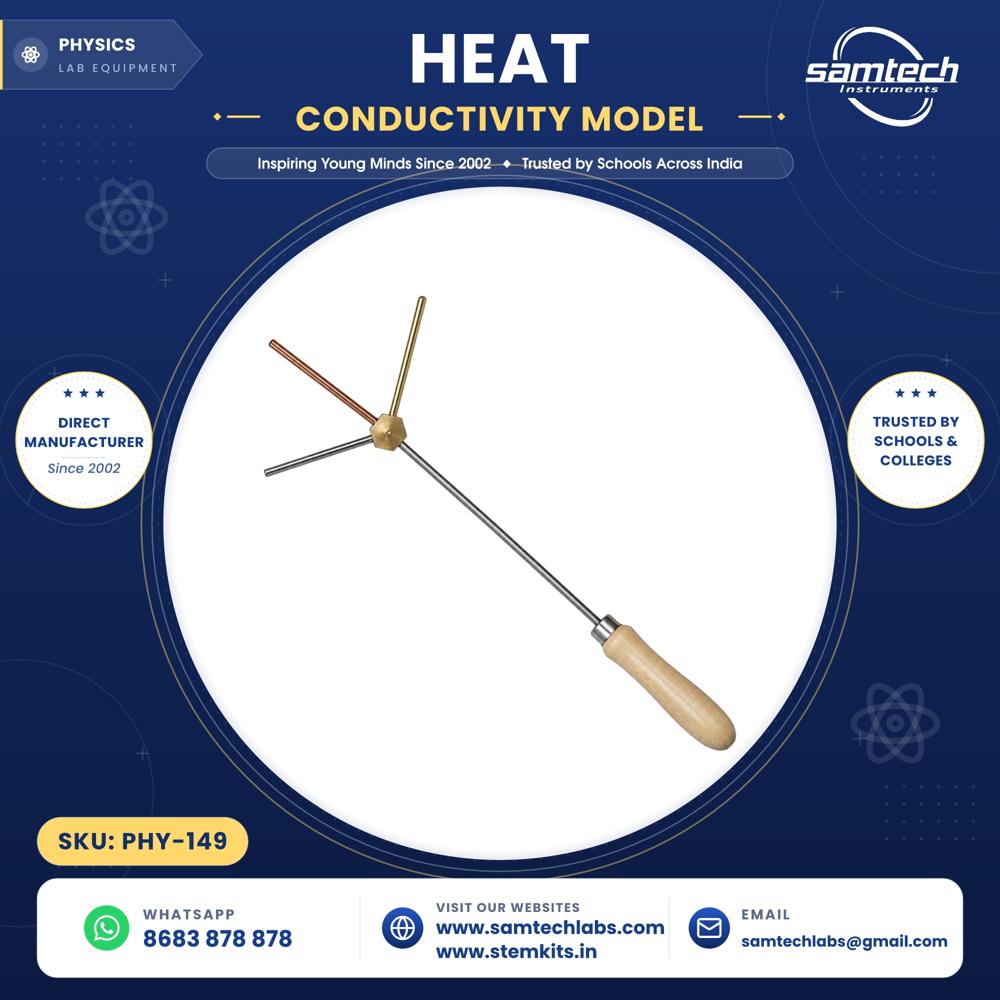
Heat Conductivity Apparatus
We are a leading manufacturer, supplier, and exporter of Heat Conductivity Apparatus designed for physics laboratories, science classrooms, and STEM education. This apparatus is used to demonstrate the thermal conductivity of different metals and helps students understand how heat is transferred through various materials at different rates.
The Heat Conductivity Apparatus consists of three metal rods made of copper, brass, and iron fixed to a central metal ring. The apparatus is mounted on a sturdy wooden handle and is supplied with wax and a spirit lamp for demonstration purposes. When the central ring is heated, heat travels through all three rods simultaneously, allowing students to observe the differences in thermal conductivity.
An additional extra-long copper rod is included to demonstrate that heat transfer requires time to travel from the hot end to the cold end, making the concept of heat conduction easier to understand through direct observation.
Experience Practical Physics LearningThis model enables direct observation of how different metals conduct heat, facilitating an interactive understanding of essential physics concepts. Suited for educational environments, it enhances both teaching and student comprehension by transforming theoretical lessons into tangible experiments.
Engineered for Safety and DurabilityConstructed from seasoned hardwood and rustproof-plated metals, the model ensures resilience and long-term use. Its safe analog display, sturdy base, and reliable thermometer make it suitable for repeated demonstrations within academic settings, all within compact dimensions and protective packaging.
FAQ's of Heat Conductivity model:
Q: How do I perform a demonstration with the Heat Conductivity Model?
A: To use this model, place it on a stable tabletop, pour hot water or another heat source along the base so it contacts the four metal plates, and observe temperature progression using the analog thermometer attached to each plate. Note how temperature differs across each metal, illustrating varying conducts of heat.
Q: What materials are included in the Heat Conductivity Model PHY-149?
A: The model comprises four metal sheets (copper, aluminum, brass, iron) mounted on a hardwood base, analog thermometers for temperature measurement, and rustproof plating for all exposed metal parts. The core components also include an individual box for safe transportation.
Q: Where is the Heat Conductivity Model best used?
A: This apparatus is designed for laboratory and classroom environments where hands-on demonstrations are valued. Its robust construction and safety features make it ideal for repeated educational use in schools, colleges, and training centers.
Q: When is this model most effective for demonstrations?
A: The model is most effective when there is a need to visually represent the principle of heat transfer during physics lessons, particularly when comparing the heat conduction properties of different metals under identical heating conditions.
Q: What benefits does this heat conduction model provide in teaching?
A: By enabling direct comparison of how each metal conducts heat, the model helps students understand the concept of thermal conductivity more concretely. This hands-on experience boosts engagement and retention of scientific principles compared to purely theoretical instruction.
Q: Is the temperature measurement on this model calibrated for precision?
A: The analog thermometer is designed for demonstrative purposes rather than precision calibration. It reliably shows general differences in heat transfer between metals but is not intended for highly precise temperature readings.
 Send Inquiry



 Send Inquiry

 Send Inquiry