About Moment of Inertia
Moment of Inertia Model
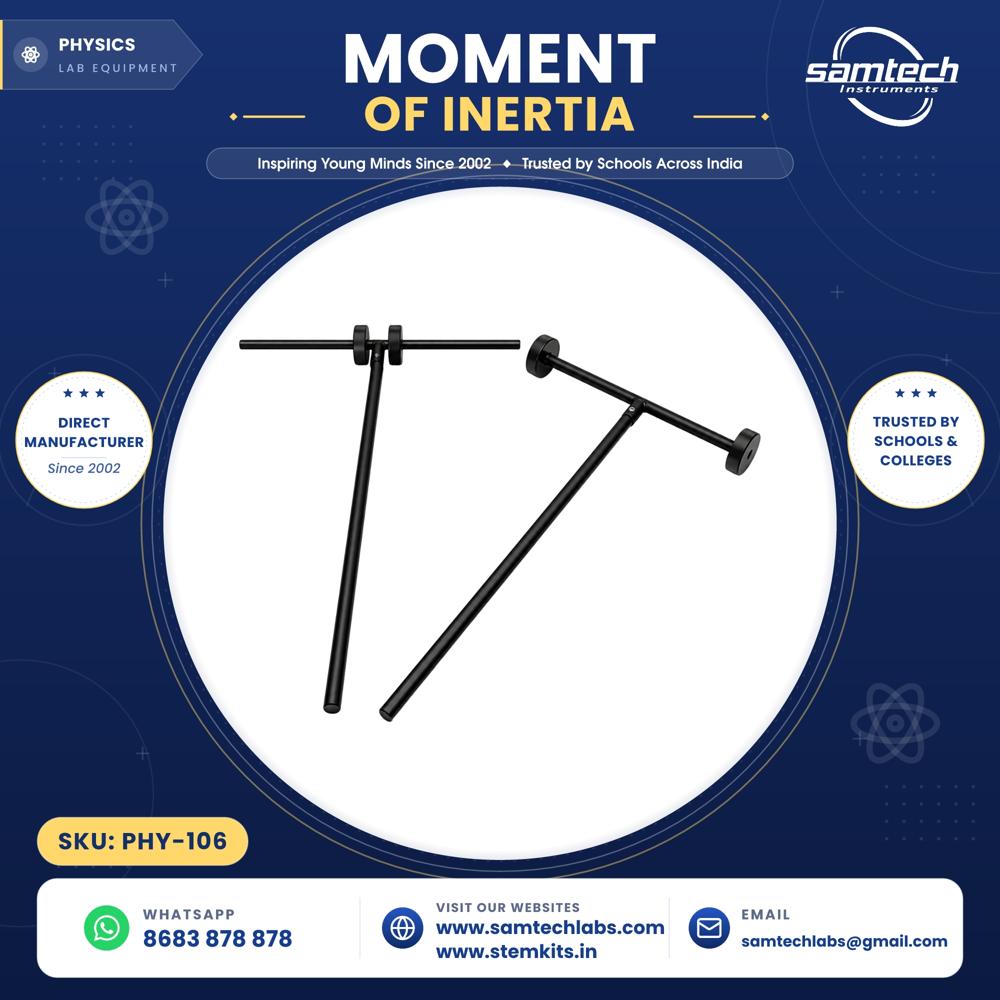
We are a leading manufacturer, supplier, and exporter of Moment of Inertia Models designed for schools, colleges, science laboratories, STEM education programs, and physics demonstrations. This educational apparatus is specially developed to demonstrate the concept of moment of inertia and the effect of mass distribution on rotational motion.
The model consists of two I-shaped metal pipe assemblies fitted with thick metal washers. In one assembly, the washers are positioned near the center, while in the second assembly, the washers are fixed at the outer ends. By comparing the rotational behavior of both assemblies, students can clearly observe how the distribution of mass affects rotational inertia. This practical demonstration makes it easier to understand one of the most important concepts in mechanics and rotational dynamics.
Precision Measurement for Physics LabsDesigned for educational and research laboratories, the PHY-106 Moment of Inertia Apparatus provides reliable and accurate readings, with a measurement precision of 0.01 gcm2. Its corrosion-resistant, powder-coated finish ensures longevity and consistent results, making it an essential tool for moment of inertia demonstrations.
User-Friendly Manual OperationWith its manual, hand-driven mechanism and analog display, the apparatus offers intuitive operation for students and instructors. Factory calibration guarantees accuracy, while the durable construction supports repeated use without compromising measurement integrity.
Versatile and Durable DesignEngineered with a heavy-duty mild steel base and robust steel rod, this equipment is built to withstand frequent laboratory use. The compact, boxed packaging allows for easy storage and transportation, making it suitable for various educational environments.
FAQ's of Moment of Inertia:
Q: How is the Moment of Inertia Apparatus operated?
A: The apparatus is hand-driven, allowing users to manually rotate the steel rod and observe the effects directly. Its analog display presents accurate readings without needing external power sources, making it simple to use during laboratory demonstrations.
Q: What is the process for measuring moment of inertia with this equipment?
A: To measure moment of inertia, weights are attached to the apparatus and the rod is rotated by hand. The analog display registers the moment of inertia, calculated based on the rotational motion and counterweight adjustment. The process is straightforward and calibrated for educational use.
Q: When should this apparatus be used in a laboratory setting?
A: This instrument is ideal for classroom demonstrations and experiments covering rotational dynamics, especially during physics lessons related to moment of inertia. Its robust manual operation allows for repeated and reliable use throughout laboratory courses.
Q: Where can the Moment of Inertia Apparatus be set up?
A: Thanks to its heavy-duty base plate and compact dimensions (350 x 250 x 350 mm), the apparatus can be installed on any stable laboratory bench or demonstration table, providing flexibility for different educational setups.
Q: What are the main components of this apparatus?
A: The equipment consists of a sturdy metal rod, a durable frame, counter weights, and a heavy-duty base plate, all crafted from mild steel for enhanced durability. The apparatus also includes an analog display for precise measurement readings.
Q: What are the benefits of using this model for physics demonstrations?
A: This apparatus offers high measurement accuracy (to 0.01 gcm2), durability, and corrosion resistance. Its manual operation encourages hands-on learning, while factory calibration ensures reliable performance in every demonstration.
Q: How does the apparatus ensure measurement accuracy and durability?
A: Manufactured from powder-coated mild steel and factory-calibrated, the apparatus minimizes error and is protected against corrosion, allowing for long-term, precise educational use up to a measurement range of 1000 gcm2.
 Send Inquiry



 Send Inquiry

 Send Inquiry