Good & Bad Conductor About
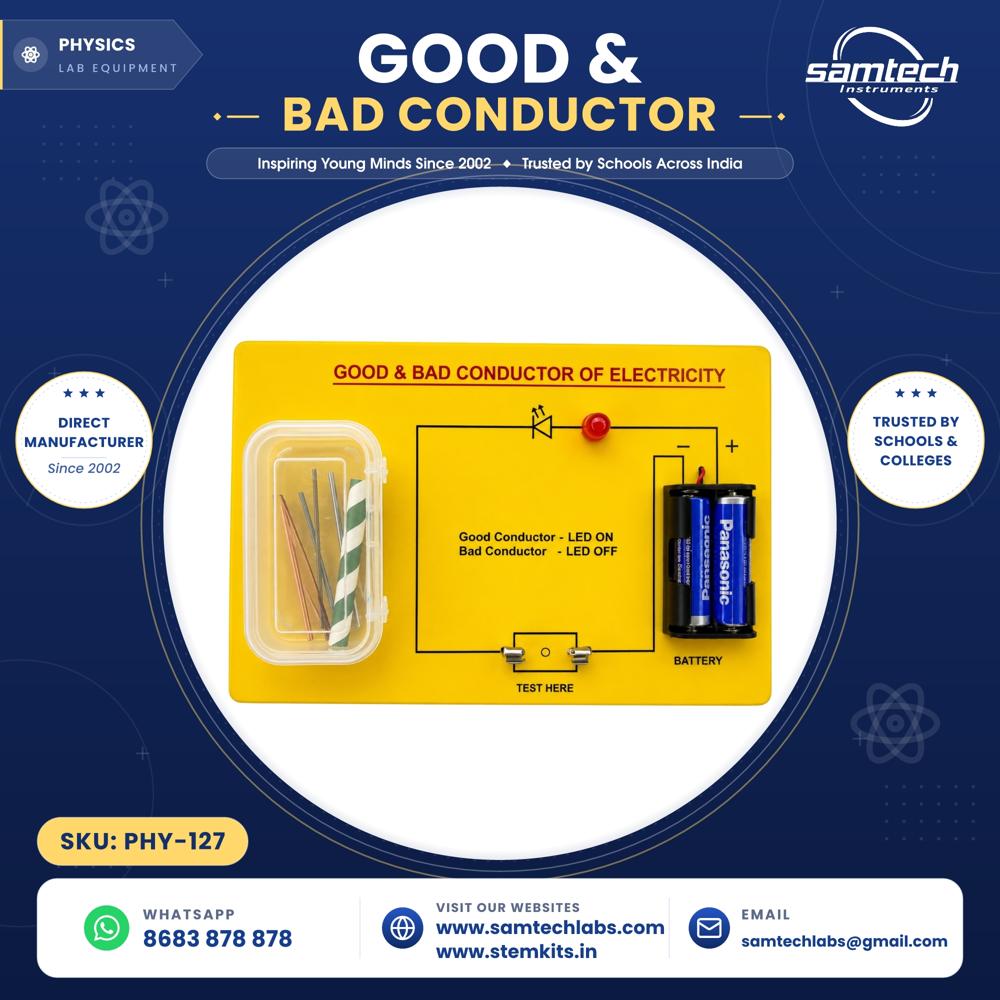
Good and Bad Conductor of Electricity Kit
We are a leading manufacturer, supplier, and exporter of Good and Bad Conductor of Electricity Kits designed for schools, science laboratories, STEM learning centers, and educational institutions. This practical science kit helps students understand the difference between conductive and insulating materials through simple hands-on experiments.
The Good and Bad Conductor of Electricity Kit demonstrates how electric current flows through different materials. Students can test various objects and observe whether the LED glows or remains off. If the LED lights up, the material is a good conductor of electricity; if it does not, the material acts as an insulator or poor conductor. This interactive learning approach makes the study of electricity engaging and easy to understand.
The kit includes a battery-powered circuit, LED indicator, testing terminals, and sample materials for conductivity testing. It is widely used in physics laboratories, science classrooms, STEM activities, and educational demonstrations.
Understand Electrical Conductivity EasilyDesigned specifically for the educational setting, this set lets students actively observe and compare the behavior of various materials as conductors or insulators. Its robust construction ensures reliable use for many experiments, enhancing classroom learning with the help of clear, visual demonstrations.
Simple and Safe Classroom DemonstrationsWith manual operation and safe voltage requirements, this kit is straightforward to use for both teachers and students. The included accessories like connecting wires and user manual simplify setup and maintenance, making it an ideal choice for everyday classroom experiments on electrical conductivity.
Practical Learning Across Educational LevelsThis kit caters to a range of grades-from primary through higher-secondary-making it a flexible teaching aid. Its qualitative approach helps develop fundamental concepts, fostering an engaging, inquiry-based learning experience for science learners of all ages.
FAQ's of Good & Bad Conductor:
Q: How do I set up the Good & Bad Conductor kit for classroom demonstrations?
A: Simply connect the rods (metal or non-metal) to the test base using the provided push or clip connectors and attach the wires to a DC power supply or battery (3V-9V DC). Follow the user manual to complete the circuit and use an indicator (bulb or light, not always included) to visually identify conductors and insulators.
Q: What types of materials are tested with this kit?
A: The kit includes conducting metal rods such as copper and aluminum, as well as non-metal samples like glass, plastic, and wood to demonstrate good and bad conductors of electricity. Other material combinations are also available upon request.
Q: When is this kit most beneficial in the educational process?
A: It is most valuable during practical science lessons on electricity, when students are introduced to the concepts of electrical conductivity and insulation. The hands-on demonstration brings theoretical concepts to life, supporting both introductory and advanced lessons.
Q: Where can I use this equipment?
A: This set is designed for use in classroom laboratories across primary, secondary, and higher-secondary educational levels. Its compact size (approx. 150 mm x 100 mm x 50 mm) and light weight make it easy to integrate into various teaching environments.
Q: What is the procedure to demonstrate good and bad conductors using this set?
A: Insert a sample rod between the terminals and complete the circuit using connecting wires. Switch on the external DC power supply; if the indicator (bulb or light) glows, the material is a good conductor; if it does not, it is a bad conductor. Repeat the process for different samples to facilitate comparison.
Q: How does this product benefit students and teachers?
A: It provides a reusable, interactive tool for mastering the basics of conductivity, helping learners distinguish between conductors and insulators. Its visual approach enhances student engagement and supports experiential learning, while teachers benefit from straightforward setup and robust construction for repeated use.
Q: Is the kit easy to clean and maintain after use?
A: Yes, thanks to its powder-coated or painted base and simple construction, the equipment can be wiped clean after demonstrations. It is designed for easy maintenance, ensuring long-term usability for multiple classes and experiments.
 Send Inquiry



 Send Inquiry

 Send Inquiry