About Flemings' Left Hand Rule
Flemings Left-Hand Rule Apparatus
Product Description
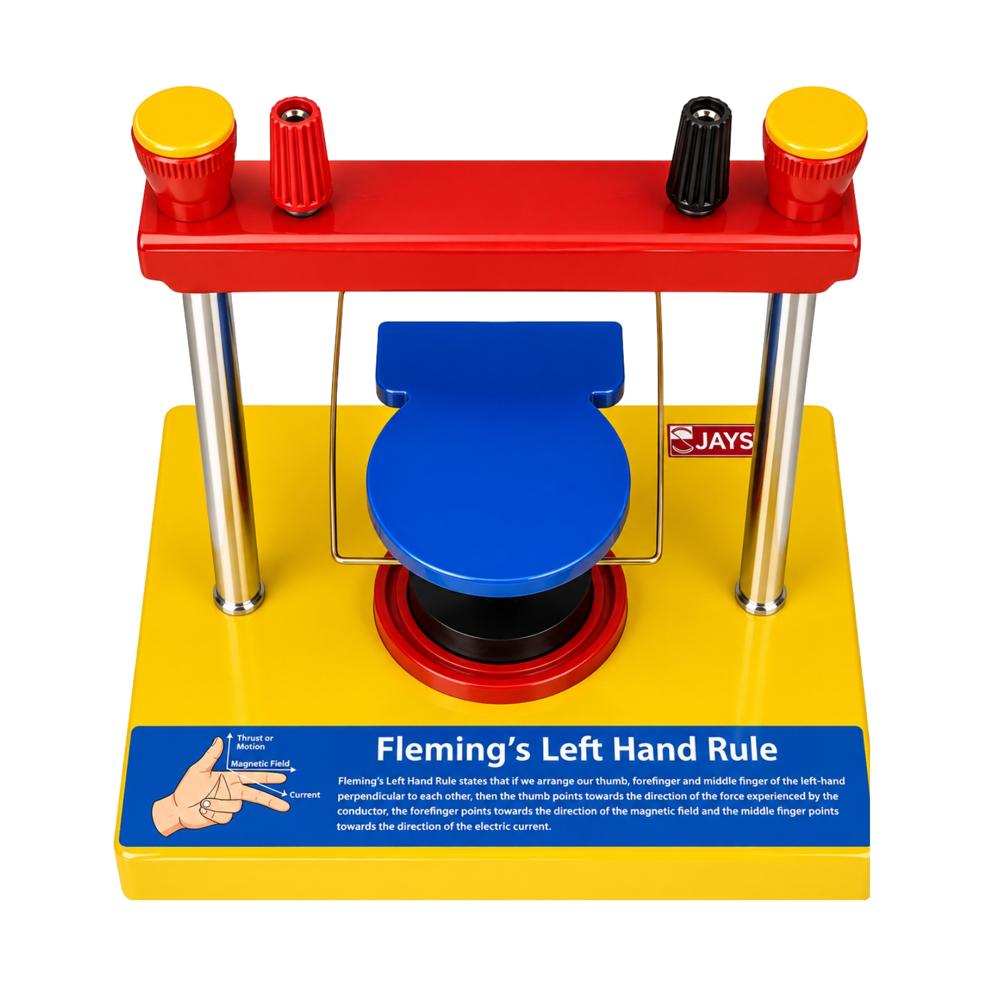
The Flemings Left-Hand Rule Apparatus is a practical physics demonstration model designed to illustrate the force experienced by a current-carrying conductor placed in a magnetic field. It provides a clear demonstration of Flemings Left-Hand Rule, helping students understand the relationship between magnetic fields, electric current, and mechanical force.
The apparatus consists of a suspended conductor positioned within a magnetic field generated by permanent magnets. When electric current passes through the conductor, the interaction between the magnetic field and the current produces a force that causes visible motion of the conductor. This enables students to observe the fundamental principle behind electric motors and electromagnetic devices.
Manufactured on a sturdy educational base with clearly marked terminals and instructional graphics, the model is ideal for classroom demonstrations, physics laboratories, STEM education programs, and science exhibitions.
Hands-On Visualization of Electromagnetic ForcesThis apparatus provides a tangible, hands-on approach for students and educators to explore the concept of electromagnetic force acting on a current-carrying conductor in a magnetic field. The clear structure-comprising a plastic base, visible copper wire or aluminum conductor, and permanent magnets-allow users to clearly observe the effects described by Fleming's Left-Hand Rule.
Built for Safety and Educational UseConstructed with non-magnetic plastic for electrical insulation and a smooth, sturdy finish, this device ensures a safe environment for learners during physical manipulation. Its anti-slip base design guarantees stability on flat surfaces, making it suitable for repeated classroom demonstrations.
Ready-to-Use Design with Complete InstructionsAssembly is not required; the device comes pre-assembled and includes a comprehensive instruction sheet. This makes it convenient for both students and teachers-just supply a DC power source (1-5V) as needed to observe the force effects, with everything else ready for immediate demonstration.
FAQ's of Flemings' Left Hand Rule:
Q: How does the Fleming's Left-Hand Rule Apparatus demonstrate electromagnetic force?
A: The apparatus uses a permanent magnet and a copper or aluminum wire conductor. When a DC current passes through the conductor placed within the magnetic field, the device visually demonstrates the force exerted on the wire, illustrating Fleming's Left-Hand Rule in action.
Q: What components are included in this educational demonstration device?
A: The device includes a smooth, insulated plastic base, a permanent bar or horseshoe magnet, a conductor (either copper or aluminum), steel supporting arms, and an anti-slip base. An instruction sheet is also provided for ease of use.
Q: Who can use this apparatus, and in what settings is it ideal?
A: This model is suitable for students, teachers, and educational institutions. It is designed for school and college laboratory settings, making it a valuable tool for physics and STEM education.
Q: Where should this apparatus be used and does it require assembly?
A: The apparatus is designed for tabletop use in classroom or laboratory environments. No assembly is needed as it comes fully assembled out of the box, ready for immediate use.
Q: What is the process for using this apparatus in a classroom demonstration?
A: Simply connect an external DC supply (typically 1-5V) to the conductor as instructed. Turn on the current, and students will observe the directional force on the wire in relation to the magnetic field, illustrating the principle of Fleming's Left-Hand Rule.
Q: What are the safety and insulation features of this device?
A: The base is made of non-magnetic plastic to ensure electrical insulation, and the anti-slip design keeps the apparatus stable during experiments, reducing the risk of accidents.
Q: How does the apparatus benefit students and educators in learning physics?
A: It provides a clear, visual explanation of electromagnetic force and the application of Fleming's Left-Hand Rule, making abstract concepts more accessible and aiding both teaching and understanding in physics or STEM labs.
 Send Inquiry



 Send Inquiry

 Send Inquiry