About Newton 's First Law
Newtons First Law Model
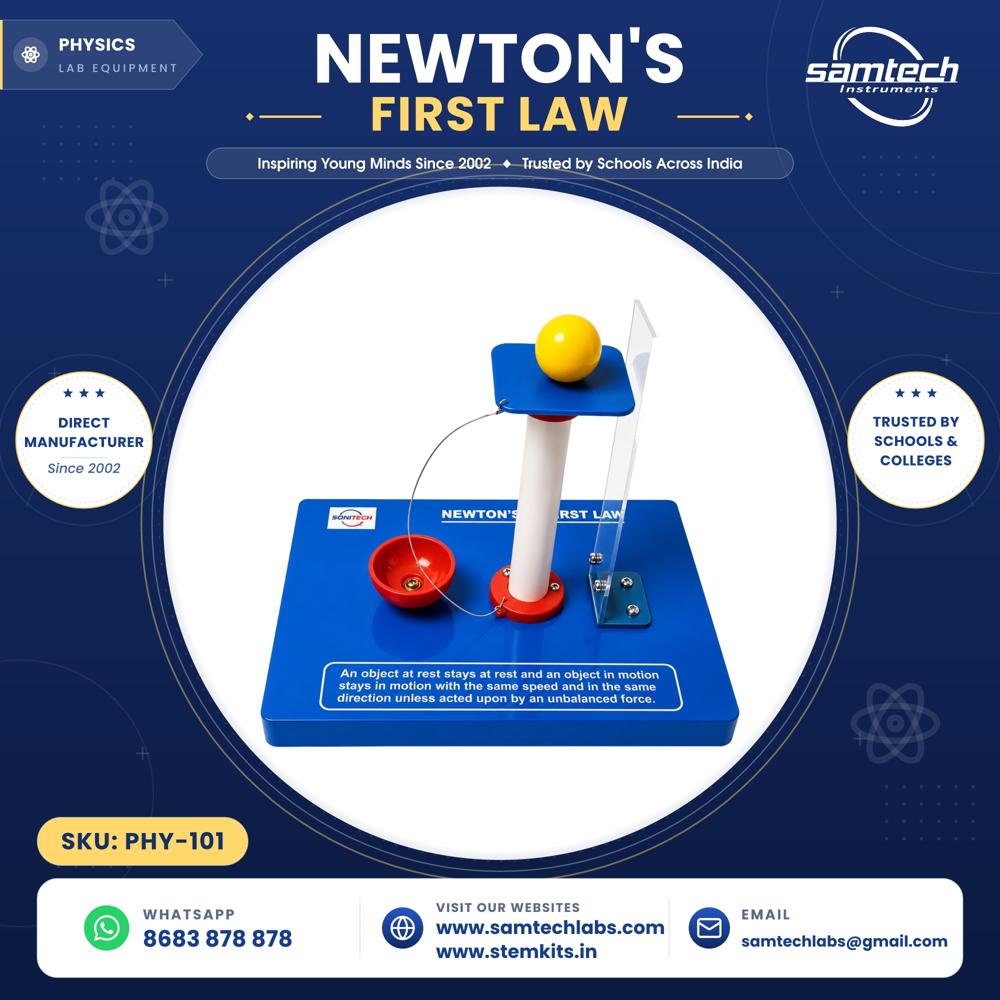
We are a leading manufacturer, supplier, and exporter of Newtons First Law Models designed for schools, colleges, science laboratories, STEM education programs, and physics demonstrations. This educational apparatus is specially developed to demonstrate Newtons First Law of Motion, also known as the Law of Inertia, helping students understand the tendency of an object to remain at rest or continue in uniform motion unless acted upon by an external force.
The model consists of a sturdy plastic base, support stand, ball, and collection cup arrangement. Through simple experimentation, students can observe how objects resist changes in their state of motion, making complex physics concepts easier to understand through hands-on learning. It is an ideal teaching aid for classroom demonstrations, laboratory activities, and science exhibitions.
Engage Students with Interactive Physics DemonstrationsBring Newton's First Law to life with this durable and attractive science model. The polished wood and painted metal parts create a visually appealing demonstration tool, while the rolling cylinder showcases the concept of inertia. Designed for both portability and classroom safety, this equipment helps instructors provide clear, memorable lessons in fundamental physics.
Safe and User-Friendly for All Educational LevelsThis model prioritizes safety and ease of use with its smooth rolling parts, child-safe design, and no sharp edges. Students from school to university can handle and operate the equipment easily. Maintenance is simple-just wipe clean with a dry cloth-ensuring long-lasting use across semesters and multiple laboratory sessions.
FAQ's of Newton 's First Low:
Q: How does this model demonstrate Newton's First Law of Motion?
A: The model uses a polished inclined plane and a rolling steel cylinder to show that an object at rest stays at rest, and an object in motion remains in motion unless acted upon by an external force. Students can observe the cylinder rolling smoothly to illustrate inertia and uniform motion.
Q: What are the recommended usage areas for this science model?
A: It is specifically designed for educational use in indoor settings such as physics laboratories and classrooms at schools, colleges, and universities, allowing instructors to provide hands-on demonstrations.
Q: When should teachers use this model during instruction?
A: Teachers can introduce the model during experiments or lessons on Newton's First Law or inertia to offer a tangible, visual supplement to theoretical explanations and textbook readings.
Q: Where should the science model be stored when not in use?
A: The apparatus should be kept indoors, preferably boxed and placed in a classroom or laboratory storage area to protect its polished and painted surfaces.
Q: What is the maintenance process for this equipment?
A: Routine maintenance involves wiping the surfaces clean with a dry cloth to preserve the polished wood and painted metal, ensuring its continued durability and attractive appearance.
Q: How is safety ensured for younger or inexperienced users?
A: Safety is maintained by using child-safe materials, rounded edges, and excluding sharp parts. The model is suitable for handling by students at various educational levels.
Q: What are the benefits of using this demonstration model in labs?
A: This hands-on tool promotes better understanding of foundational physics principles, increases student engagement, and facilitates active participation in lessons, making complex theories easier to grasp.
 Send Inquiry




 Send Inquiry

 Send Inquiry