About Simple Circuit Board
Simple Circuit Board
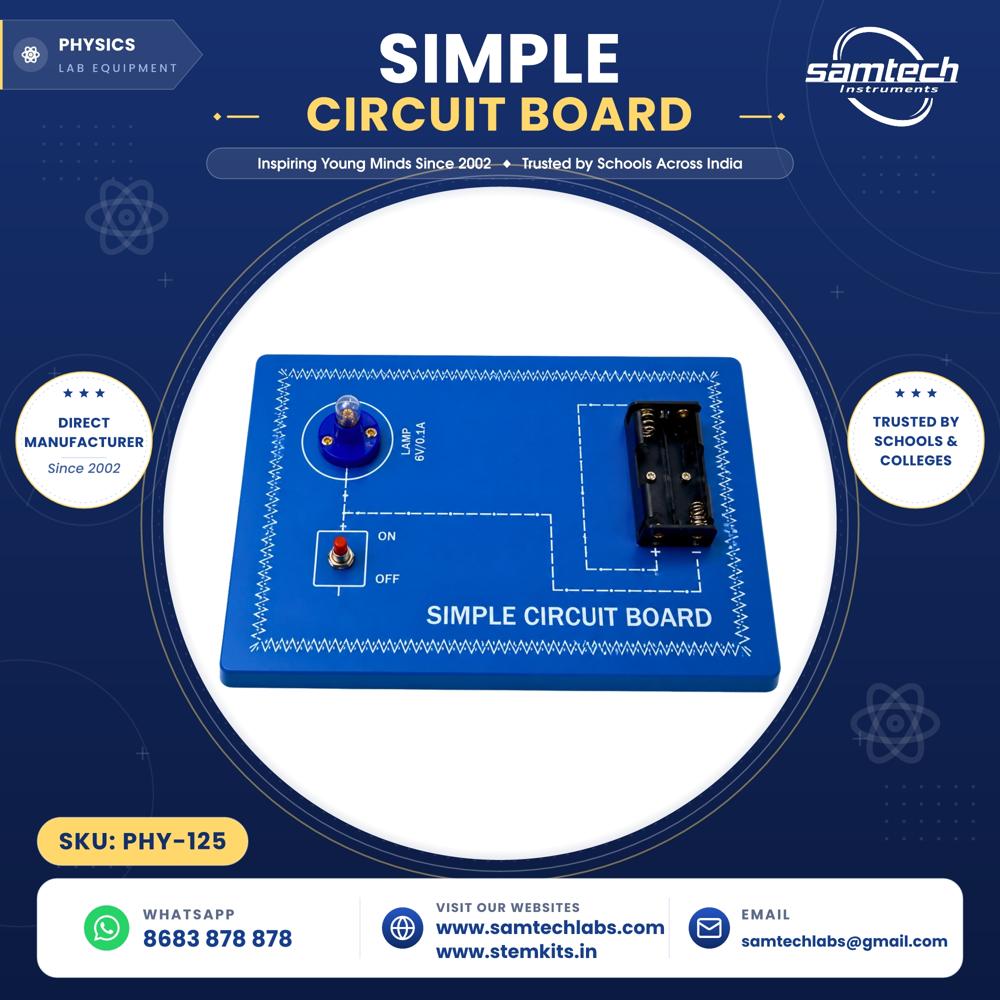
We are a leading manufacturer, supplier, and exporter of Simple Circuit Boards designed for physics laboratories, electronics education, STEM learning programs, and science classrooms. This educational model provides a practical introduction to the fundamentals of electrical circuits, helping students understand how electricity flows through a complete circuit.
The Simple Circuit Board consists of a lamp holder, bulb, switch, battery holder, and clearly marked circuit connections mounted on a durable base. Students can easily observe the effect of opening and closing the circuit, making it an ideal teaching aid for demonstrating basic electrical principles.
This hands-on educational apparatus helps learners understand circuit continuity, electrical flow, switches, conductors, and the importance of a complete electrical path.
Reliable and Durable PCB ConstructionFeaturing a sturdy FR4 base paired with copper tracks and a green solder mask, the PHY-125 circuit board is engineered for durability and repeated use. Its HASL surface finish supports easy soldering, while RoHS compliance assures environmental safety. With single-sided or double-sided variants and standard copper thickness, the board is designed to handle voltages up to 30V DC and frequencies up to 1 MHz, making it a dependable choice for most low-frequency electronics tasks.
Versatile Usage ScenariosThis simple circuit board excels in a variety of settings, including prototype development, educational classrooms, and electronics testing. Supporting both through-hole and SMD components, it is extremely adaptable. The board can be powered using external DC sources or batteries (3V-12V depending on circuit design), making it ideal for hands-on training, DIY projects, and iterative experiments.
FAQ's of Simple Circuit Board:
Q: How do I mount components onto this simple circuit board?
A: You can mount components using either through-hole or surface-mount device (SMD) methods. The PCB is compatible with both, enabling flexible assembly for various project requirements. Soldering is straightforward due to the HASL finish and minimum trace width of 0.254mm.
Q: What types of projects are best suited for this circuit board?
A: This board is ideal for prototype development, educational demonstrations, electronics testing, and general-purpose circuit assembly. Its basic routing, easy soldering, and reusability make it convenient for beginners and experienced users alike.
Q: When should I use a single-sided versus a double-sided board?
A: Single-sided boards work well for simpler circuits with few connections, while double-sided boards are preferable for more complex designs where additional routing space is required. Choose the type that best matches your circuit complexity and component density.
Q: Where can I use this board considering environmental conditions?
A: The board operates reliably in environments with 0% to 90% relative humidity (non-condensing). However, always store and use it in dry, non-condensing areas to maintain optimal performance and longevity.
Q: What is the typical process for reusing this board?
A: After initial use, you can desolder components carefully and clean the board before remounting new parts. The FR4 substrate and robust HASL finish allow multiple reuses as long as proper handling is maintained.
Q: What are the key benefits of using this circuit board for educational purposes?
A: The PHY-125 offers a clear, accessible platform for learning circuit assembly, teaching soldering skills, and training in basic electronics. Its reusability and support for both through-hole and SMD components make it versatile for hands-on classroom activities.
Q: How do I power circuits built on this board?
A: Connect an external DC power supply or appropriate battery (3V-12V depending on your components). Ensure the supplied voltage and current are within your circuit's limits and the board's maximum voltage rating of 30V DC.
 Send Inquiry



 Send Inquiry

 Send Inquiry